
How to Get a Driving Licence in Austria: Step-by-Step Guide
Driving across Austrian alpine passes and suburban networks offers unmatched convenience, but learning how to get a driving licence in Austria requires navigating a multi-stage training framework (Mehrphasenausbildung) governed by the Federal Ministry for Climate Action, Environment, Energy, Mobility, Innovation and Technology (BMK). Whether you enroll in a local driving school (Fahrschule) or transfer an existing foreign permit, this step-by-step guide covers mandatory requirements, testing steps, total costs, and road test preparation.
Visit our European driving license page if your if your interested in getting a fully registered license without sitting for the test.

Standard Requirements for a Driving Licence
Before registering at a driving school or submitting documents to the driving licence authority (Führerscheinbehörde), confirm you meet all legal prerequisites.
1. Age, Residency, and Medical Fitness
-
Minimum Age: You can begin driving school instruction at 17.5 years old for the standard Class B licence (or 15.5 years old under the early L17 program). You must be at least 18 years old to take the practical exam and receive a standard licence.
-
Residency Status: You must be legally registered in Austria with a primary residence (Hauptwohnsitz) and reside in the country for at least 185 days per year.
-
Medical Certificate (Ärztliches Gutachten): You must pass a medical check-up conducted by an authorized doctor (Führerscheinarzt) confirming physical fitness.
-
First-Aid Course (Erste-Hilfe-Kurs): Completion of a mandatory 6-hour emergency life-saving course (provided by organizations like the Austrian Red Cross) is required before taking the practical exam.
2. Mandatory Document Checklist
Bring original copies of these items when registering at your selected Fahrschule:
-
Proof of Identity: Valid passport or EU national ID card.
-
Proof of Residence: Official civil registration document (Meldezettel).
-
Medical Certificate: Form signed by an authorized Austrian physician.
-
First-Aid Certificate: Official 6-hour Erste-Hilfe-Kurs completion card.
-
Passport Photo: Biometric photo meeting official national criteria (35mm x 45mm).
For official regulations and portal access, visit the official oesterreich.gv.at Licensing Guide.
Step-by-Step Driving Licence Application Steps
The Austrian Category B licensing framework relies on initial instruction followed by a mandatory post-licence phase.
[Medical & First-Aid Checks] ➔ [Fahrschule Theory & Lessons] ➔ [CBR Computer Theory Test] ➔ [Practical Road Test]
Step 1: Enroll in a Driving School (Fahrschule)
Submit your identification documents to an accredited Fahrschule. The driving school registers your profile directly in the national driving licence register (Führerscheinregister).
Step 2: Complete Theory Training and Pass the Computerized Exam
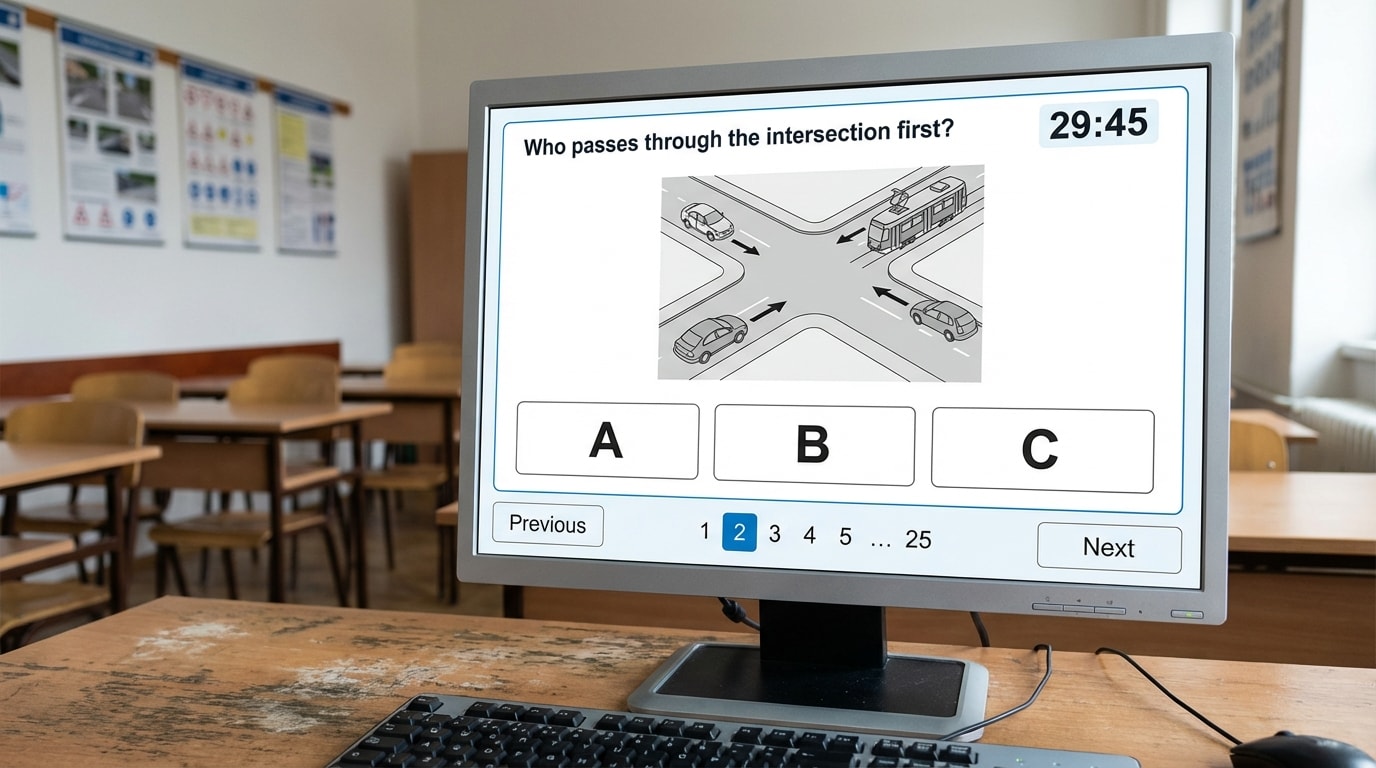
Attend mandatory classroom theory instruction (covering general traffic laws, road signs, and vehicle tech).
-
Exam Format: A computer-based multiple-choice test taken at your driving school. You must complete two modules (Basic Knowledge + Class B Specifics) drawn from a nationwide question bank. Passing awards theory certification.
Step 3: Complete Practical Driving Instruction
Standard Class B training requires a minimum of 18 practical driving hours (50 minutes each) with a certified instructor. Instruction covers basic vehicle handling, highway driving (Überlandfahrt), night driving, and city navigation.
Step 4: Pass the Practical Road Test (Fahrprüfung)
Schedule your road test through your driving school. The 45-minute evaluation includes:
-
Vehicle Safety Check: Explaining dashboard indicators, tire tread, or engine fluids.
-
Parking & Maneuvering: Demonstrating reverse parallel parking or three-point turns.
-
Road Driving: Navigating urban traffic, roundabouts, and priority intersections smoothly.
Upon passing, the examiner issues a temporary paper licence (Vorläufiger Führerschein) valid in Austria for 4 weeks while your plastic card (Scheckkartenführerschein) arrives by post.
Step 5: Complete the Mandatory Second Phase (Mehrphasenausbildung)
Within 12 months of passing your test, all new drivers must complete three additional follow-up modules:
-
1st Feedback Drive (1. Perfektionsfahrt): 2 to 4 months after passing.
-
Driver Safety Training & Psychology (Fahrsicherheitstraining): 3 to 9 months after passing (includes skid-pad training).
-
2nd Feedback Drive (2. Perfektionsfahrt): 6 to 12 months after passing.
Breakdown: Total Cost of a Driving Licence
Acquiring a driving licence in Austria is a significant investment due to comprehensive driving school packages and second-phase requirements. Below is a realistic cost breakdown in Euros (€):
| Application Stage | Description of Fee / Expense | Estimated Cost (€ EUR) |
| First-Aid Course | Mandatory 6-hour Erste-Hilfe-Kurs | €50 – €70 |
| Medical Examination | Doctor’s health certificate fee | €35 – €50 |
| Fahrschule Package (B) | Theory course, 18 driving hours, & exam entries | €1,400 – €2,200 |
| Official Authorities & Card Fee | Licensing office issuance & registration fees | €60 – €90 |
| Second Phase Training | Safety course + 2 feedback drives (Mehrphasenausbildung) | €300 – €450 |
In total, expect to budget between €1,800 and €2,800 across the entire multi-stage process. Visit our European driving license page if your interested in getting a fully registered German Driving License without sitting for the exam or the test.
Practical Driving Test Tips for Beginners
Examiners evaluate spatial awareness, hazard management, and strict compliance with national priority rules.
Essential Road Safety Rules
-
Priority to the Right (Rechtsregel): At unmarked intersections, always yield to vehicles approaching from your right.
-
Emergency Corridor (Rettungsgasse): On motorways (Autobahn), drivers must form a clear center lane for emergency vehicles during traffic slowdowns.
-
Tram Priority: Trams always have priority when moving on dedicated rails; yield before turning across tram tracks.
Frequently Asked Questions (FAQ)
Can I exchange a foreign driver’s licence in Austria?
Licences issued by EU/EEA member states are valid indefinitely and can be converted voluntarily. Non-EU/EEA licence holders can drive for up to 6 months after registering their Meldezettel. After 6 months, you must exchange your permit (Umschreibung). Depending on reciprocity agreements (e.g., US, UK, Canada, Australia), you may only need a medical check or a practical road exam rather than repeating full driving school coursework.
What is the L17 driving program?
The L17 program allows teenagers to start training at age 15.5. After completing driving school basics, candidates complete 3,000 km of supervised driving with a designated family member before taking their practical exam at age 17.
Summary
Learning how to get a driving licence in Austria relies on selecting a trusted Fahrschule, passing your computer theory test, and completing both your practical exam and second-phase safety modules. Organize your identity documents, book your medical check, and start your journey toward driving across Austria!
Contact us for assistant in get a German driving license without you sitting for the test.
[…] Holders of EU/EEA driving licences can use their permits indefinitely or exchange them voluntarily without taking tests. Non-EU licence holders (e.g., from the UK, USA, or Ukraine) who reside in Poland for more than 185 days must exchange their foreign permit for a Polish one. Drivers from countries outside Geneva/Vienna traffic conventions must pass the WORD state theory test before the exchange is granted. For comparison with other EU guidelines, see our Austria driving licence guide. […]